You caught a beauty!!!
************
************

************
Download PDF of scaffold here.
theory behind the scaffold…
How do we reach our conclusions about the importance we put on different skills sets and what we focus on to develop in our lessons? In general, whether we are aware of it or not (and we need to become aware of it!), the importance placed on different skills is tied to social values.
A capitalistic society values linguistic-verbal and mathematical-logical skill, while a communal society places more value on interpersonal and intrapersonal abilities.*
In the same respect, the values highlighted in different cultures dictate the amount of focus those cognitive skills have in the sphere of education: the importance placed on those areas provide the motivation to become skilled in those areas.
In this global environment, we need to help our students to develop as many skills as possible so that they are qualified for a myriad of situations. To do this, we create opportunities for them to learn through as many different learning styles as possible*. Some students in your class might be able to function in the classroom language linguistically without the need for other means of adaption. On the other hand, many of your students need visuals, audio, verbal, kinesthetics or physical interaction with the material – or any combination of these – to assimilate new knowledge.
For Pre-School and Lower Primary, the challenge is infusing students with linguistics without obligating them to read or write. Those who follow the thinking of 7-year increments of learning and human development in general, will be following the educational practice of liberating students from the obligation to read and write until the child turns 7-8 years old. There is not forbidding a child to read and write, but educators who follow this practice will do the reading and writing for the students until they have passed the 7-year mark.
For those who are the bench about this methodology, this scaffold gives students the opportunity to interact with material both through linguistics and visuals. As in the best-planned activities, specific language outcomes are included to give teachers benchmarks. Too often we focus only on content, but being specific about the language structure, grammar and clarity of meaning ahead of time, teachers become clearer about the goals of the lesson and, in turn, their students feel more supported and are, therefore, more willing to confidently participate.
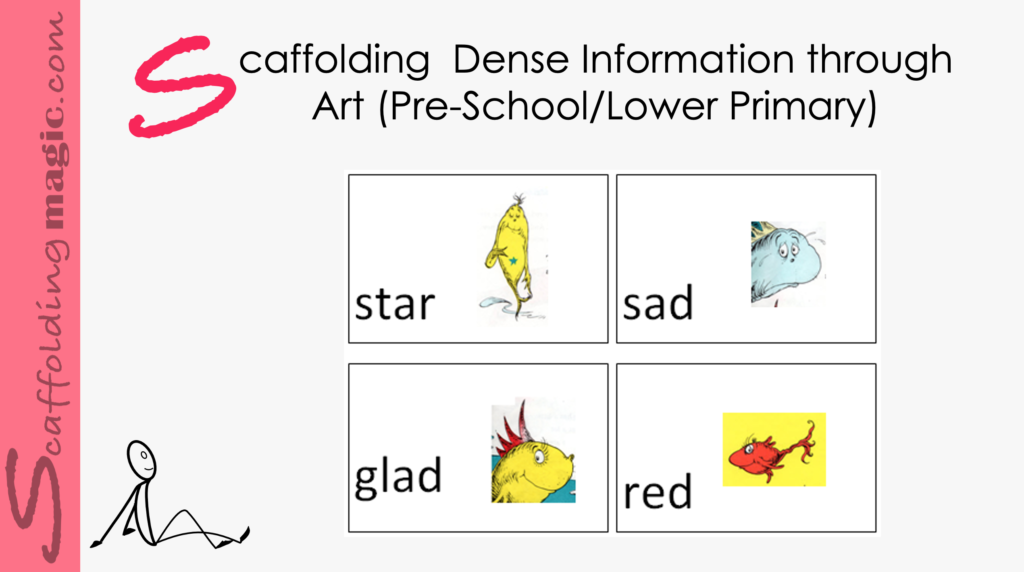
We use One Fish, Two Fish by Dr. Seuss in this activity, and you’ll see how you can adapt it to virtually any topic you’re about to begin.
*Garcia, Ofelia (2009). Bilingual Education in the 21st Century: A Global perspective. Singapore. Wiley-Blackwell.
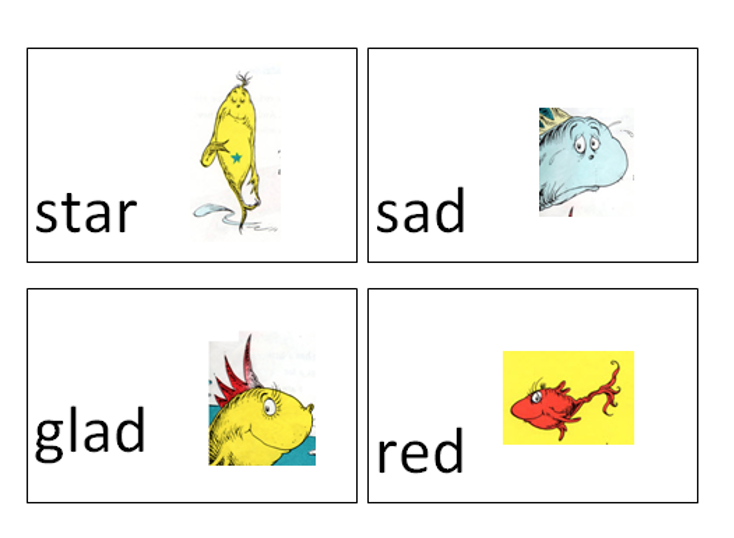
- Choose 10-15 images from the unit, video, story, game you’re about to begin. Place them each in a text box and include one word that describes something about the image. (Template)
- Show students these images and give them time to repeat key vocabulary. IMPORTANT: even though you’ve only put one word under each image, have them practice saying complete sentences. (Ex.: ‘This fish has a star.’ ‘This fish is sad.’ ‘This fish is glad.’ ‘This fish is red.’)
- In the spaces in each textbox, students draw themselves with the corresponding emotion, concept, word, image, etc. It does not matter how basic these drawings are. What we are looking for is a connection between the students the concept. They can focus on any part of each image in the text box. For instance, in the textbox with the fish with the star, they can draw themselves with a star on their face or body, while in the textbox with the glad fish, they can draw themselves happy, etc.
- Students share their drawings with a classmate and they explain each drawing to the other. This may be in their home language, with hopefully one or two words in the classroom language. (Example: This is me with a star (classroom language) on my forehead. This is me with a red (classroom language) shirt.)
- Read the story to them and let students show their drawings and act out the concepts of the words that have been highlighted in the textboxes.

Scaffoldingmagic.com is your entryway into DYNAMIC bilingual learning methodologies, such as Phenomenon-Based Learning, CLIL, EMI, and ESL. You’ll find ways to implement critical thinking tools (DOK) to promote higher level thinking, the growth mindset, instill an ethic of excellence, deep reflection on learning, and all through multi-cultural, interdisciplinary activities. We have the keys to turning competences into action and to creating collective efficacy in your school so you move ahead as a unified, enthusiastic team.