
You caught a beauty!!!
************

************

************
Download PDF of scaffold here.
‘The mind is not designed for thinking.’* These are probably not the words you were looking for when you set out on the search for ideas on how to motivate your students. And yet, the experts insist that it’s true. We tend to rely on memory – the resource that’s easiest to access – when we are confronted with any task. Critical thinking can be taught but only through techniques, and these techniques are domain specific. This means that a strategy that works in one subject may not work in another. Therefore, as educators, by understanding this contradiction, we need to help our students to fill their toolbox of critical thinking techniques so that they can be successful in as many areas as possible.
This scaffold presents one technique you can use to combat this human tendency of laziness – of relying on memory instead of working actively to further knowledge. We use here a social science lesson on global migration, and you’ll see how you can adapt it to any lesson you’re about to begin.
- Choose or find an image from a unit that best represents one key element of the lesson you are about to begin.
Example: In this case, we’ve chosen a world map that is central to the unit the students are about to begin.
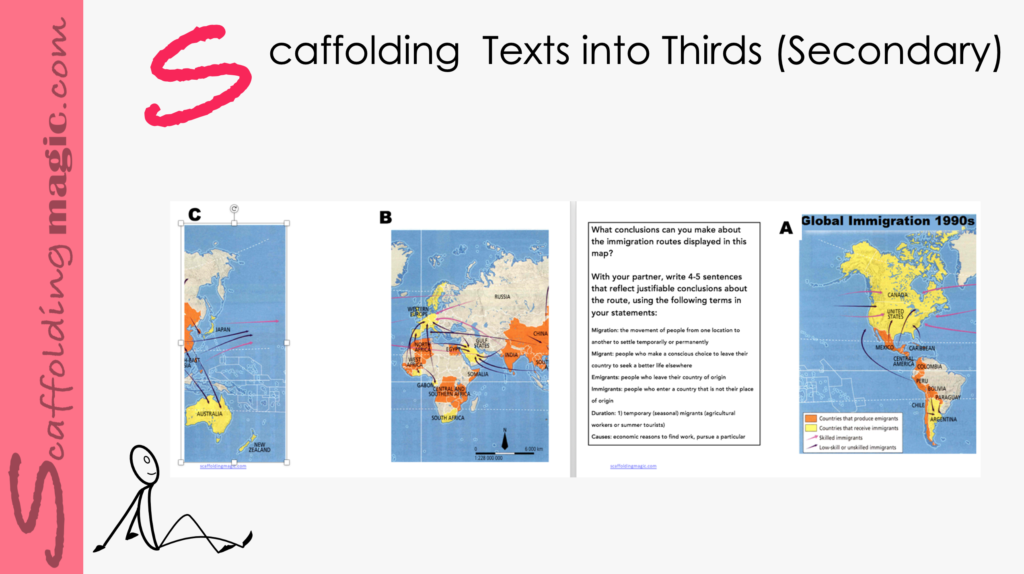
- You can digitally or physically cut the image into thirds and paste (digitally or physically) each third on one page of a piece of paper folded into a mini-book.
- Place the divided images on pages 1, 3 and 4 of a mini-book. (See video for example.)
4. On one of the pages of the mini-book, include the academic language and/or definitions of key terms so that your students will need to be able to verbally answer the questions you’ll also include. You can give translations in this list of vocabulary to aid further in reducing stress and raising confidence. (See template for example.)
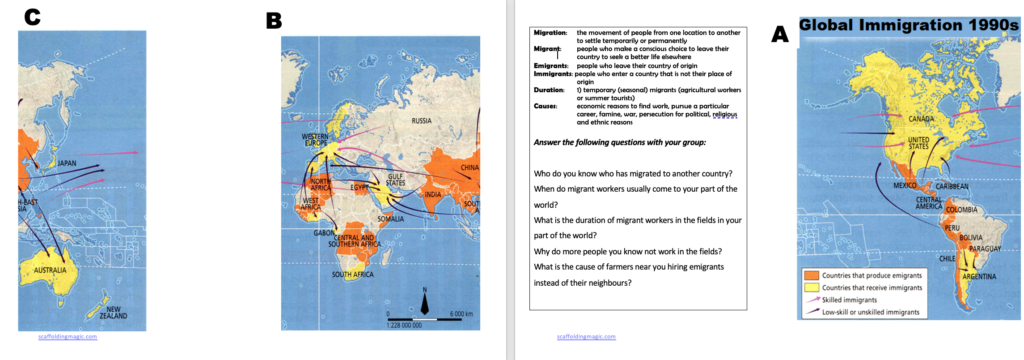
- Place the divided images on pages 1, 3 and 4 of a mini-book. (See video for example.)
- Students work in pairs. They begin verbalising the images they see, making suppositions, and sharing conclusions on the 1/3 of the image on the first page of the mini-book. If they need help, they look for academic language on the second (or last) page of the mini-book that will help them to continue to verbalise their observations.
images one at a time. You want them to learn to make suppositions. The idea is for them to use critical thinking to identify what they are looking at while also commenting on what does not appear. Once they’ve verbalised everything they see on the first third of the image, they proceed to the second third. They then continue verbalising what they see and confirm or correct the suppositions they made when talking about the first third. They continue this dynamic with the last third.
If they looked at the next page immediately, they would find the answers, but they would have lost the opportunity to stretch their minds and think about other possibilities there could be on the next page. Remind them that it’s okay to make mistakes. Errors actually help the brain grow. If students are not making errors (making suppositions that later turn out not to be accurate), they are not stretching themselves.**
Example of a conversation between students: Page 1 of Mini-Book (1/3 of image):
Image A:
Student 1: In image A, there are many skilled immigrants coming from the East.
Student 2: Yes, they may be coming from Europe, from Africa, or from the Middle East.
Student 1: Yes, they are more from the west, and they are probably coming in from China or Indonesia.
Student 2: They are probably not seasonal immigrants.
Student 1: No, but there are unskilled immigrants coming in from North, Central and South America and some from the West.
Student 2: They are probably seasonal immigrants.
Image B:
Student 1: In image B, we can now see that the skilled immigrants entering the United States come from Western Europe, Russia and India.
Student 2: Yes, they are not coming from Africa. They are probably seeking careers.
Student 1: Yes, you’re right. On the other hand, the unskilled workers from North, Central and South America are probably coming in for seasonal work, as we said before.
Etc.
- Formative Assessment: Show students a similar image that represents a bit more of the topic you’re going to study (so that students can recycle at least some of the academic language they practiced during the activity.) Groups discuss all images, Secretaries synthesise the conclusions, and Reporters share the information they’ve been able to identify
- Reflection: Students write 100-150 words on how they felt about learning by dividing up the information into chunks and only focusing on part of the information at a time.
Video showing mini-book in use
Willingham, Daniel T. (2007) ‘Critical Thinking: Why is it so hard to teach?’
** Hattie, 2017 (p. 207)
Podcasts on introducing topics to pre-school students.

Scaffoldingmagic.com is your entryway into DYNAMIC bilingual learning methodologies, such as Phenomenon-Based Learning, CLIL, EMI, and ESL. You’ll find ways to implement critical thinking tools (DOK) to promote higher level thinking, the growth mindset, instill an ethic of excellence, deep reflection on learning, and all through multi-cultural, interdisciplinary activities. We have the keys to turning competences into action and to creating collective efficacy in your school so you move ahead as a unified, enthusiastic team.