You caught a beauty!!!

************

************

************
Download PDF of scaffold here.
theory behind scaffold…
We all know by now (pretend that you do, even if you don’t!!!) that teaching critical thinking is a never-ending job. Critical thinking strategies are domain sensitive, which simply means that a strategy that works in art may not work in history, and a strategy that works in for a verbal deliberation may not work in a situation that requires physical movement, etc.
Critical thinking strategies also have to do with past knowledge. There is a fascinating study of a students that elucidates this dynamic to perfection:
- A group of Chinese and another group of North American students were given an exam with problems based on a version of Hansel and Gretel most familiar to North American children.
- Seventy-five percent (75%) of the American students were successful in finding the solution to the problems given to them while less than 20% of the Chinese students – not familiar with the story as it is told in Western cultures – were able to reach conclusions that were relevant.
- The two groups were then given an exam with problems based on a common Chinese folk tale. In this case, the percentage of students from each culture who reached successful solutions, was reversed.
The conclusions were that, to a large extent, when the versions of the story the students considered were not familiar to them (when the situation was foreign to them), they did not have a strong enough basis to find the underlying message of the story during the time structure of the exam and without other support.*
Further conclusions are that critical thinking strategies can become embedded in our consciousness the more we are exposed to them – the more opportunities we give our students to use them. This, in turn, helps them to be more successful in viewing situations from many angles and on many levels.
So what can we do? Well, instead following our first instinct and throwing up our hands, thinking that the task is so vast that we might as well not even begin, we can instead look at all this as an opportunity to expand our practice. We can take this as an excuse to widen even further the variety of strategies we use in our classroom activities so that when our students go out into the world, they’ll be more prepared because of this little extra effort we put into our lessons.
We add to this repetition. As was illustrated in the scenario above with the Chinese and North American students, repetition of strategies is essential in giving our students more of a likelihood to assimilate strategies more deeply. Transitioning from interacting with information on a superficial level to a deeper level, many times simply requires repeated exposure to a specific strategy.
In this scaffold, your young learners students have the opportunity to develop their verbal and visual skills as they create connections through logic and deciphering.
step by step…
- Choose 5-10 images from the story you’re about to read, a video you’re about to watch, a song you’re about to sing together, a game you’re about to play, copy them and present them in a PPT or on a poster.
- For yourself, identify the academic language you want your students to be familiar with before you begin (we follow the philosophy that until a child is 7-years-old, reading skills ought not to be stressed, so this activity does not include the students identifying letters or words.)
- For older students (5-year-olds), make sets for each pair so they can follow along with you once you’ve done the activity at least once. This encourages your young learners to receive the message early on that knowledge is not in the front of the room, it is right in front of them, where they sit.
- In circle, model the activity, then students work together to:
- identify colours, clothes, objects, animals, nature, etc.
- give directions of location (upper right, middle right, lower right, upper left, middle left, lower left).*
Example using images from Pete the Cat:
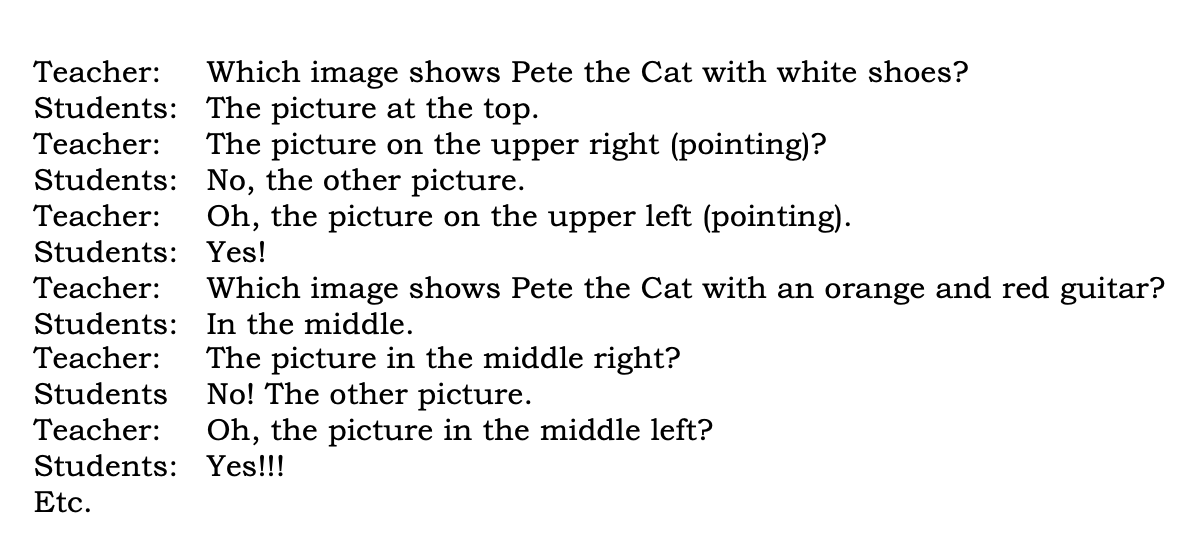
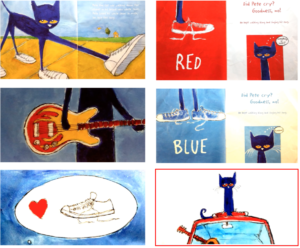
- Formative assessment: In circle again, show images and students verbalise what they see using the words they learned during the activity.
- Reflection Students tell their partner whether they liked the activity and whether they feel they learned a lot from participating in it.
*If you follow the philosophy of high expectations, you will model these concepts and your students will learn them fluidly, with practice and repetition.
video explanation…

Scaffoldingmagic.com is your entryway into DYNAMIC bilingual learning methodologies, such as Phenomenon-Based Learning, CLIL, EMI, and ESL. You’ll find ways to implement critical thinking tools (DOK) to promote higher level thinking, the growth mindset, instill an ethic of excellence, deep reflection on learning, and all through multi-cultural, interdisciplinary activities. We have the keys to turning competences into action and to creating collective efficacy in your school so you move ahead as a unified, enthusiastic team.