
You caught a beauty!!!

************

************

************
Download PDF of scaffold here.
theory behind scaffold…
Many ESL teachers will questions the importance of teaching and using classic literature in their classes. We probably all agree that it is not easy to teach in its authentic form as it demands a high level of language proficiency and maturity for any student, and especially students those whose home language is different from that of the class text.
Nevertheless, through varied techniques, the reading of authentic classic literature is an incredibly enriching experience (although your students may not appreciate or admit this until years later!). Presented creatively, you may find that otherwise uninterested students will happily participate in activities that include:
- role-playing using their own scripts in colloquial language
- songs written with alternative endings of the plot
- debates on contentious concepts from the stories
- artwork that represents overall themes
These activities are ways for students to review/clarify details of the stories and so be able to interact with the literature more confidently.
The same scaffolding activity can be used as and introduction or review (perhaps with certain modifications) for summative evaluations. Below, we’ll consider a scaffolding activity designed for a summative assessment on Jane Austin’s Pride and Prejudice We add here a Mini-Lesson which shows how in this case, the summative assessment becomes, in fact, a formative assessment: students are given the opportunity to to evaluate their knowledge before the final exam. They take a trial exam to test their knowledge on the subject, then, in the best practices of the Ethic of Excellence, they have the opportunity to correct their own divergent answers to construct them more cohesively.
These summative/formative assessments are adapted from Dylan Wiliam’s brilliant book Embedded Formative Assessments.
See how you can adapt this Mini-Lesson to your own needs.
excerpt from Comprehensive Guide to Phenomenon-Based Learning Volume 2…
Towards the end of the school year, I decided to introduce what I thought would be a light choice in the annals of classic literature: Jane Austin’s Pride and Prejudice. I’m a slow learner when it comes to believing that everyone enjoys the written word as much as I do. So, I was surprised when I found my students to be less than enthusiastic when given the opportunity to decipher the twists and turns of Austin’s prose. The joys of Austin’s irony and disdain for form – in a society that existed precisely because of a co-agreement of form – eluded my students precisely because of her verbosity. (Yes, just like Austin, I can be pretty wordy!)
Of course, you’re probably thinking: ‘How could you be so thick? This is the social media generation, accustomed to thoughts expressed in less than 300 characters and 18-second reels.’ But I was determined to widen their verbal pallet. To do this, I needed to dangle something shiny in front of them, and that was of course to make the book personal – to help them to see that the crazy antics of Austin’s 19th century nobility mirror the crazy choices of the most colourful characters they are devoted to following in social media.
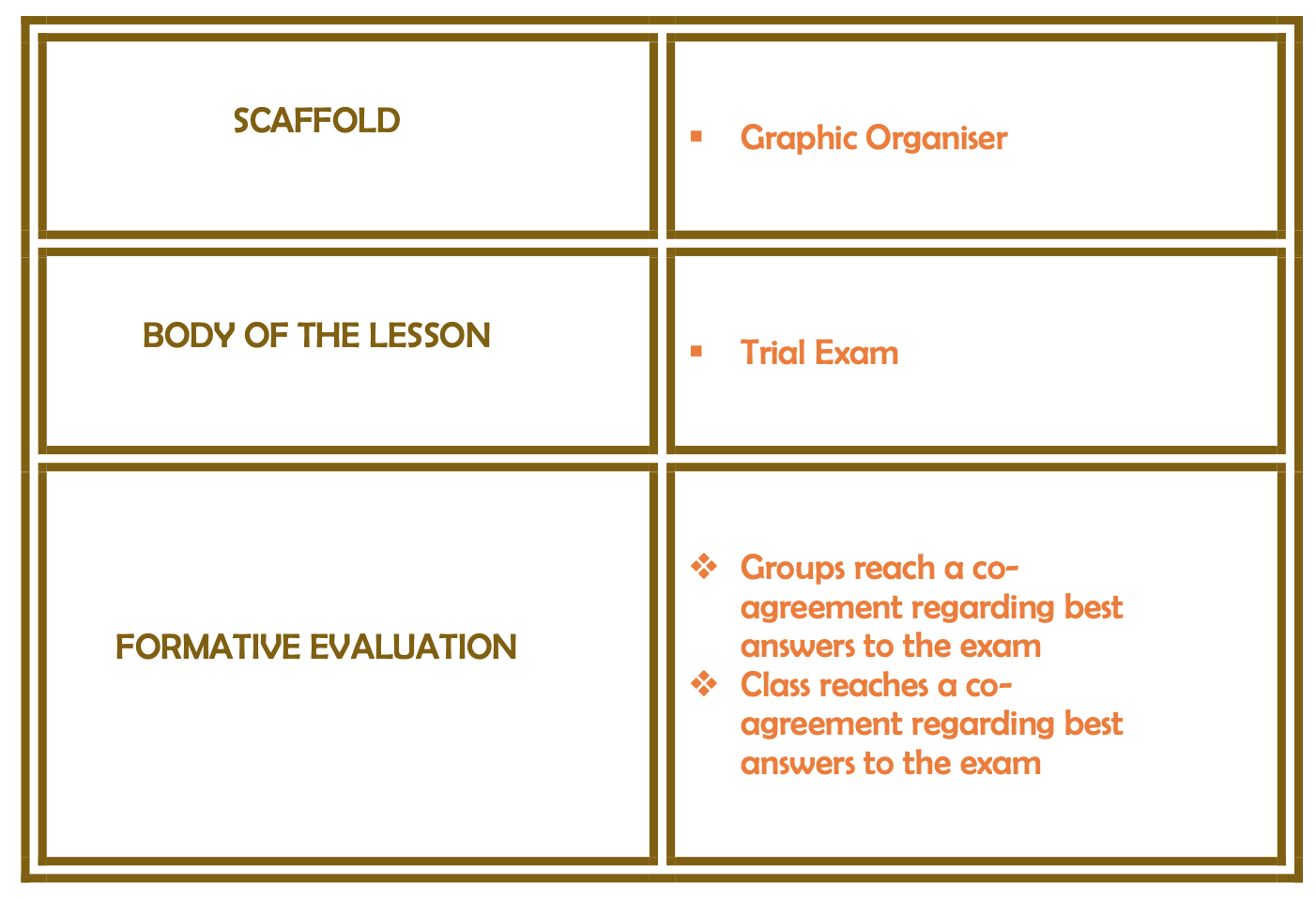
The first step was to create a Mini-Lesson with a scaffold that organises the characters of the novel not just by familial ties, but by their similarities in choosing and repulsing relationships. This is a different sort of scaffold; one that is continuous and, after it is clarified, is used throughout the reading of the book. You periodically share information and let groups compare, contrast, discuss, negotiate their conclusions. The graphic organiser you’ll see below gives order to the ebbs and flows of the story and also shows that, though our 21st century students are directed by the ebbs and flow technology, human characteristics haven’t changed in centuries.
You’ll see that the Body of the Lesson of this Mini-Lesson is a trial exam. A trial exam???? you’re probably asking yourself. If you’re at all familiar with the Team Based Learning structure, you’ll know that exams can be a fantastic way of evaluating knowledge. It’s designed to be not only a learning experience but a formative evaluation as well. It will show if and where students have holes in their knowledge base so that you can plan accordingly.
In the third step of the Mini-Lesson, the Formative Assessment, I’ve included elements of the Ethics of Excellence. In this case, the teacher doesn’t correct the trial exam, but rather the students do in their groups. They work together to form what they feel are the best answers to the questions on the trial exam according to a compilation of all their answers. Later, the class joins together to reach a consensus on the information.
This is the template of the graphic organiser you can use:

These Mini-Lessons turned the tide. By adopting a Growth Mindset and personifying that outlook in my classes, I gave my students the opportunity to participate in activities in alternative ways (other than simply linguisticaly), and so they found that they could enjoy the plots and characters of the stories. By being able to build strong platforms of detail, they could then use their cerebral energy to uncovering hidden symbolism and meaning, which meant that they would be able to reach more original conclusions in their Final Tasks.
In short, the Mini-Lessons, inculcated with 21st century skills, create a dynamic in which the authentic language of the classic literature became less intimidating for my reticent literature students, facilitating more productive group work on their projects.
In a PhBL project, we need to be attentive to our students’ needs and learning styles. One way the Growth Mindset manifests during projects is when we make determinations to foment our students’ knowledge base through Mini-Lessons. When we give them opportunities to clarify doubts through activities that celebrate different learning styles, we send our students the message that not only do we trust their ability to succeed, but that we support them in helping that to happen.
Mini-Lesson…
Jane Austin: Pride and Prejudice
scaffold step by step…
This is one of those books that’s an easy sell to most students. Well, in my experience – to those students who love gossip, breaking down character flaws of the people around them, anticipating disastrous social dynamics of a party they had attended the weekend before, etc. Pride and Prejudice develops characters and has twists in plots that are fairly universally satisfying (and utopic!) no matter the century.
I have found that the easiest way to engage students in the story is to marry the reading of it to watching clips of the mini-series version. (I am a deep believer in authenticity in literature and the 1995 version is so true to the book that it’s easy to plan chapter by chapter with the time segments of this version. Please resist the newer versions.) Though at first my students watched this mini-series frowning, in a very short time, they began begging me to play it even during their break times. (Try not to – they’ll stop reading!).
While I encourage you to resist newer versions of this book, i would strongly encourage you to disregard that recommendation for one version only: the Bollywood version: Bride and Prejudice. Hysterical, satisfying and true to the story, all at once.
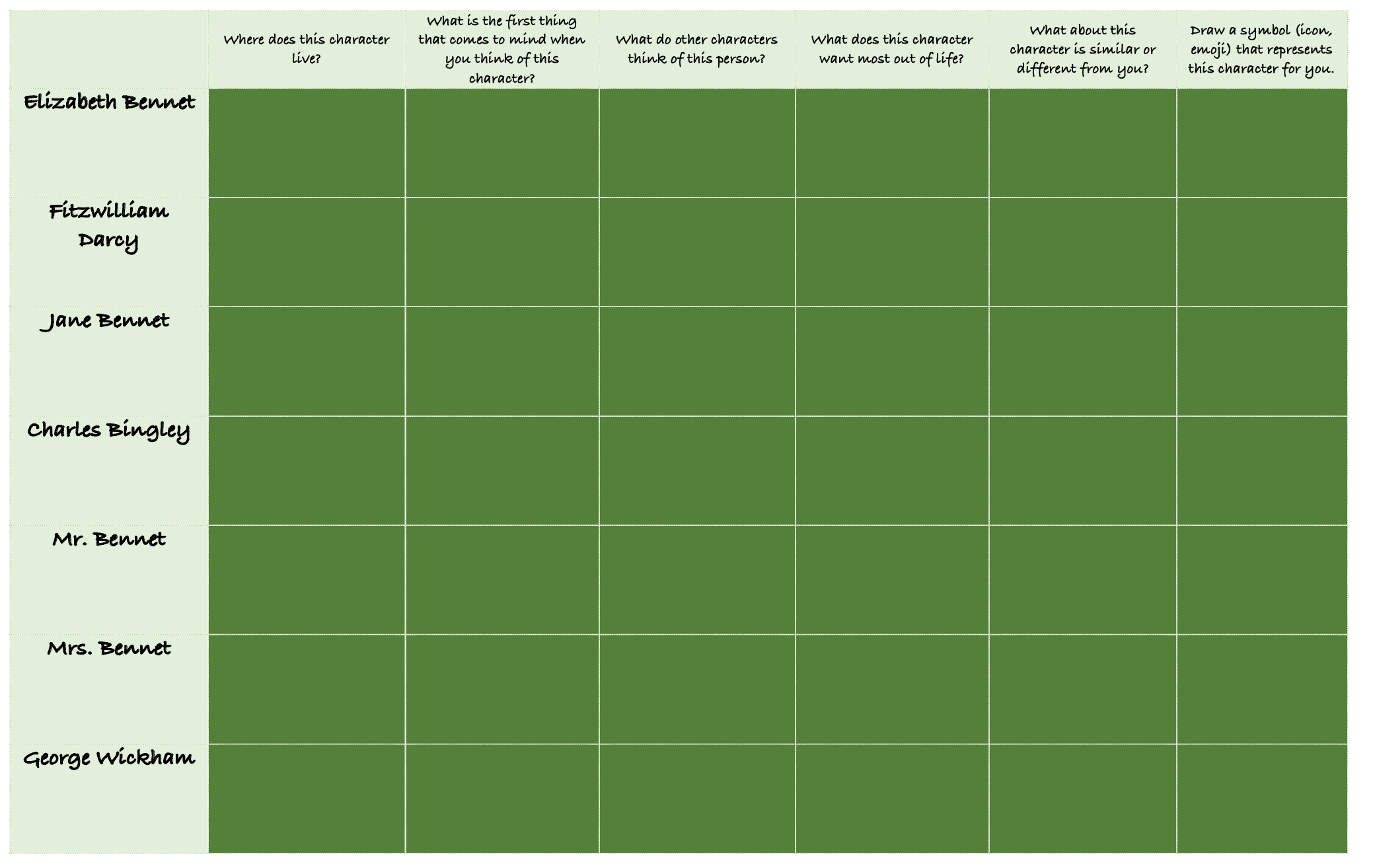
In the meantime, here is a scaffold that will help your students keep track of the many characters in the story. Aside from the facts and family trees which can help enormously in following the plot, the graph encourages the students to pay attention to personalities and actions so they can make connections to them and people in their own lives – a key in engaging our students.
At various times during the reading of the book, students work in pairs to fill in the graphic organiser. Have a class discussion before the final exam to reach a consensus on the information you feel is most important.

Scaffoldingmagic.com is your entryway into DYNAMIC bilingual learning methodologies, such as Phenomenon-Based Learning, CLIL, EMI, and ESL. You’ll find ways to implement critical thinking tools (DOK) to promote higher level thinking, the growth mindset, instill an ethic of excellence, deep reflection on learning, and all through multi-cultural, interdisciplinary activities. We have the keys to turning competences into action and to creating collective efficacy in your school so you move ahead as a unified, enthusiastic team.