
You caught a beauty!!!
************

************

************
Download PDF of scaffold here.
theory behind scaffold…
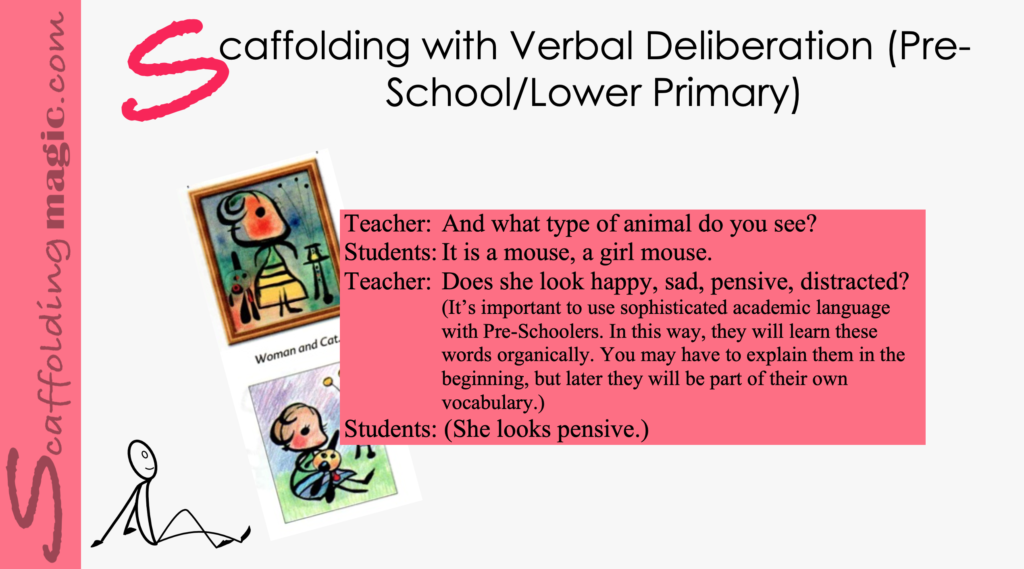
Language is the most powerful, most readily available tool we have for representing the world to ourselves and ourselves to the world.* Up until three years of age, children organise information visually. After this turning point, they need to verbalise knowledge to understand it.* Presenting activities that give them the opportunity to verbalise what they see, helps them to develop more language.
Much of the materials they will see in their later school years is depersonalised – that is, the texts are presented in a way that does not reach out to them, does not include them, the language is written in passive, or it ignores the reader. We can take advantage of the time we have with them as very young learners and help them learn to connect and verbalise as much of what we present to them in the classroom as possible. Most Pre-School teachers are masters at infusing material with connections; what we forget to do, however, is to let students take this responsibility, and make connections for themselves.
This scaffold encourages students to become personally involved in whatever images they see or stories that listen to. The technique includes using verbal reasoning to aid in the reading of new material – so that the Pre-Schoolers have the opportunity to build mental representations of the words connected to the images and/or stories through critical thinking and deliberation. The active dialogue while reading helps them to maintain active nodes (that might otherwise be passive), and the construct of knowledge then becomes stronger and can be accessed longer.
This scaffold fills this void. The technique uses critical thinking and verbal deliberation to make connections with what seems impersonal. Our young students will be actively dialoguing with each other while they consider images, listen to songs, or stories and this helps their brains to remain active. In this way, they’ll remember the material more deeply and for longer. The example we give here is from an art lesson, and you’ll see how you can adapt it to whatever story you are going to present.
step by step…
- Choose a story, song or images that are in the unit you’re about to begin.
- As a class, you can model the activity and then see if your students can work in pairs and repeat it together.
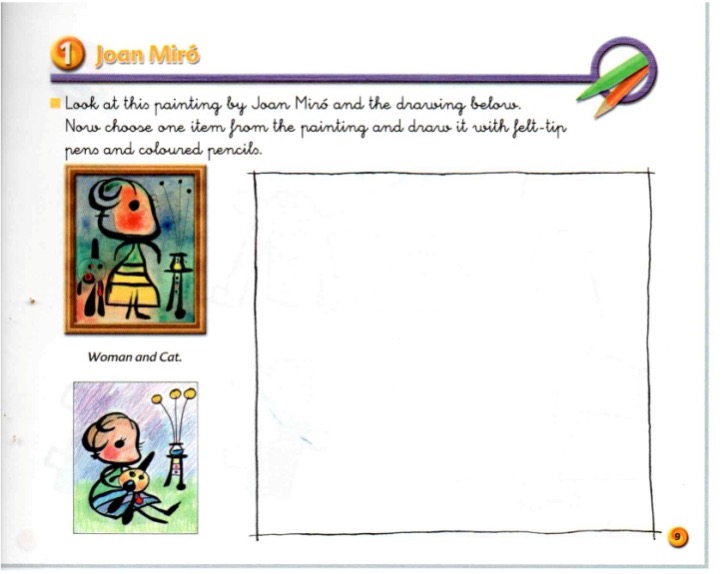
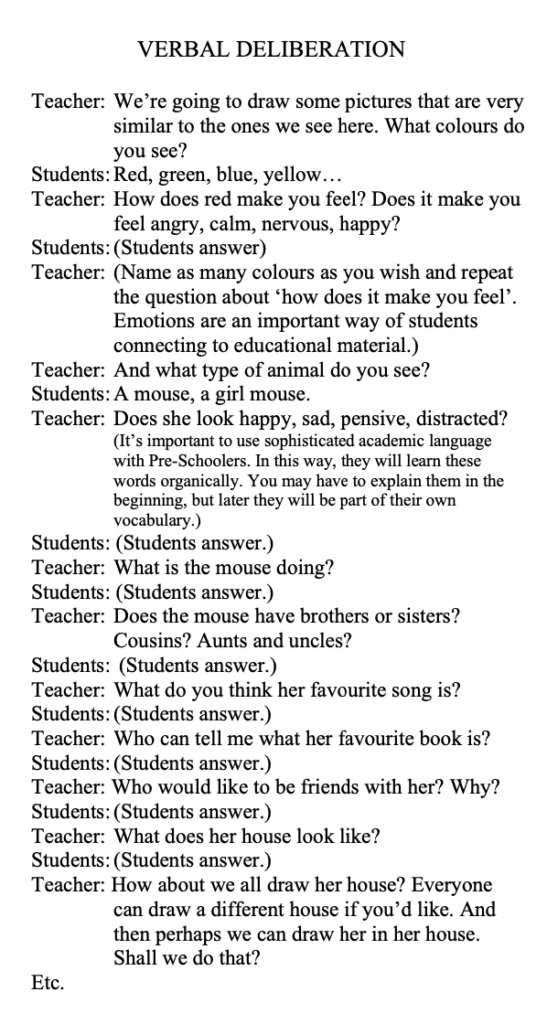
- Formative assessment: Give pairs of students a second illustration and they can work in pairs to verbally deliberate the images they see.
- Reflection: Students tell their partner if they liked inventing details about the characters they saw in the illustration (or the animals they heard in a song, or the people they heard about in a story, etc.), and why.
* National Council of Teachers of English [NCTE] & International Reading Association [IRA], 1996, p. 12
**Toward a Definition of Verbal Reasoning in Higher Education (pp. 10-11)
***Historical Thinking and other Unnatural Acts (p. 72)

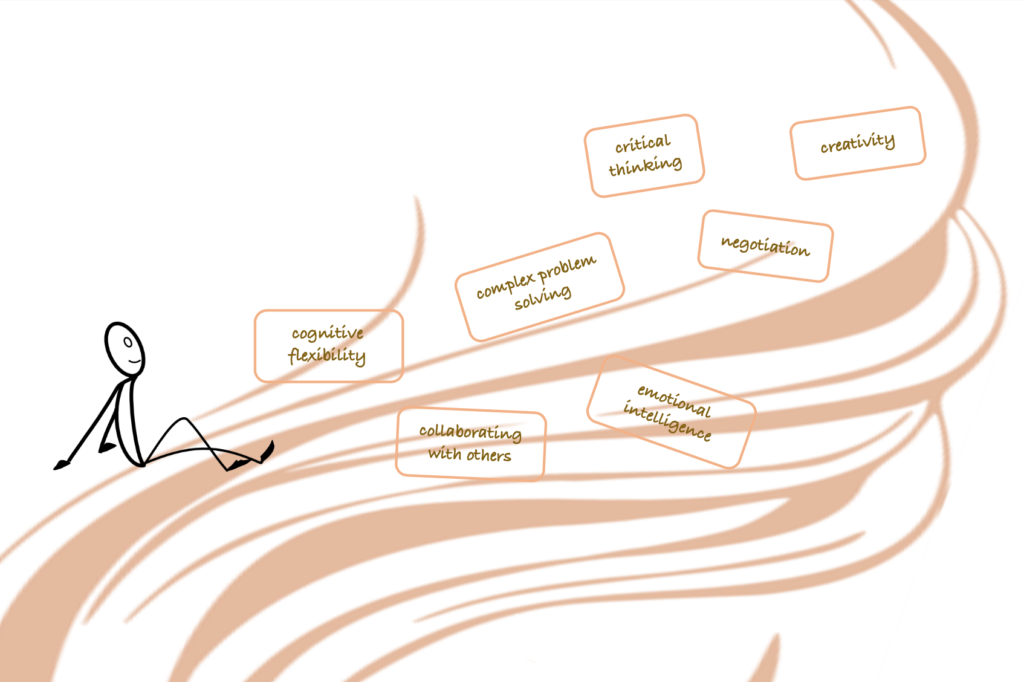
Scaffoldingmagic.com is your entryway into DYNAMIC bilingual learning methodologies, such as Phenomenon-Based Learning, CLIL, EMI, and ESL. You’ll find ways to implement critical thinking tools (DOK) to promote higher level thinking, the growth mindset, instill an ethic of excellence, deep reflection on learning, and all through multi-cultural, interdisciplinary activities. We have the keys to turning competences into action and to creating collective efficacy in your school so you move ahead as a unified, enthusiastic team.