
You caught a beauty!!!

************

************

************
Download PDF of scaffold here.
theory behind scaffold…
Knowing the sequence of events in a text, story, video, laboratory experiment, sports competition, musical composition, preparation of art materials, etc. is an essential skill for students. This is an integral part of Pre-school and Lower-Primary school lessons, but it is often forgotten in higher grades.
Sequencing is a concept that needs to be repeated throughout the education process. We need to intentionally give our students the opportunities to be able to recognise and express sequences, and we need to provide the phrases they can use to clarify the ordering of events. It might be motivating to know that studies show that students are able to recall information more accurately if they´ve been schooled in sequencing.
The art of ordering is a skill that requires critical thinking as it obligates the students to see both sides of an issue, be open to new evidence, and deduce and infer conclusions from available facts.* Inferential reasoning enables students to construct new knowledge by considering, connecting past knowledge to new. If we want to delve into the biology of the skill, you might be interested to know that the dynamic activates the hippocampus, which is the part of the brain responsible for retaining short-term, long-term and spatial memory. So, the more we give students the opportunity to develop this part of the brain, the more we are aiding them in strengthening neuron connections.
In this scaffold, students have a platform to not only review the concept of sequencing, but also to use creative skills in filling in events that did – or might have – occurred between the given information included in the activity.
In other words, our students are encouraged to develop inferential reasoning. They order events that have happened, and then fill in missing information that is insinuated, or that they imagine happened – through educated inferencing.
Sequencing events in course work involves comprehension strategies that include repetitive sequencing phrases such as: ‘Initially,’ ‘Eventually’, ‘Finally’, etc. If practiced regularly, these phrases automatically trigger a sense of time and order and give students clues as to the trajectory of whatever is being addressed.
This scaffold will show how we can naturally use our course materials – indexes, instructions, timelines, images, etc. – to raise comprehension of material and reinforce sequencing skills. Using a social science lesson about peaceful revolution and including the life of Ghandi, we’ll focus on the phrases: ‘In the beginning…’, ‘Next’, ‘In the end…’; however, depending on the lesson you are about to present, you may decide to introduce other phrases. The list below will help you choose.
step by step…
- Choose the information to use in this activity (15-20 images from a text, a video, the instructions to a laboratory experiment, the steps to take to prepare materials in an art class, the notes to a piece of music your students are going to learn, etc. (If you are going to use a video you can do ‘Capture Screen’ to get the 15-20 images to use for this activity.)
- Place the images out of order on an A4 piece of paper as handouts for students.
3. Make the chart below visible and add any other sequencing phrases you’d like your students to use.**
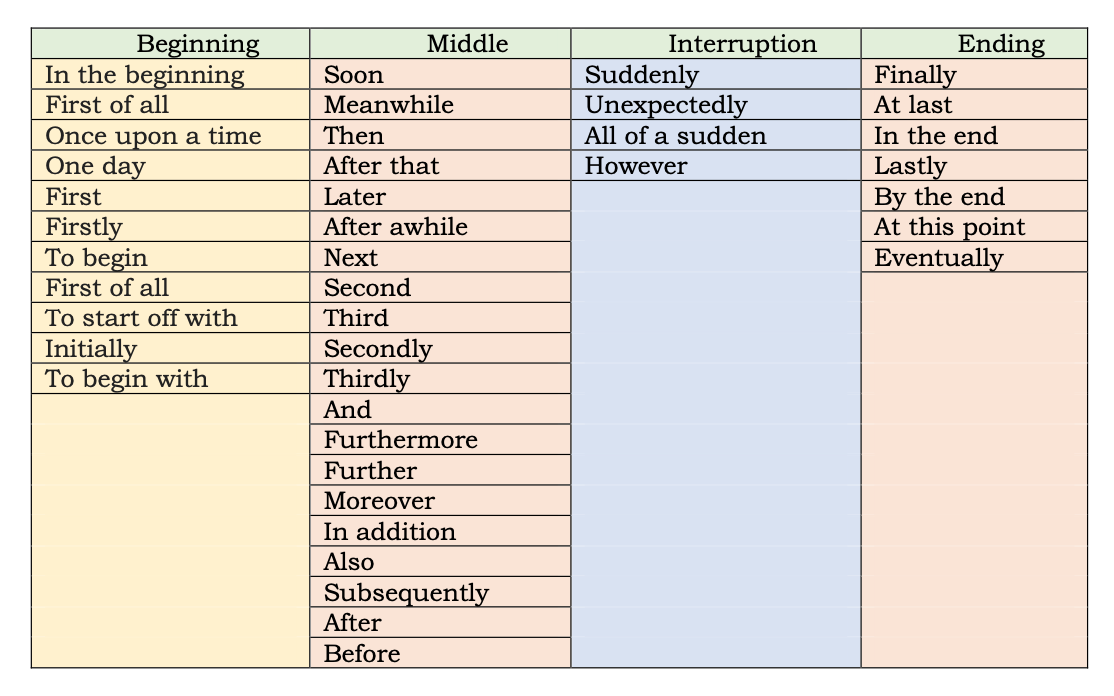
- Create a PPT with the same images so that you can begin the activity by modelling possible conversations students have together.)
- Using student volunteers, model the activity. In this case we’ve chosen images of Gandhi from his youth through adulthood, with captions underneath so that students have enough information from which to form sentences and accurately sequence his political evolution.
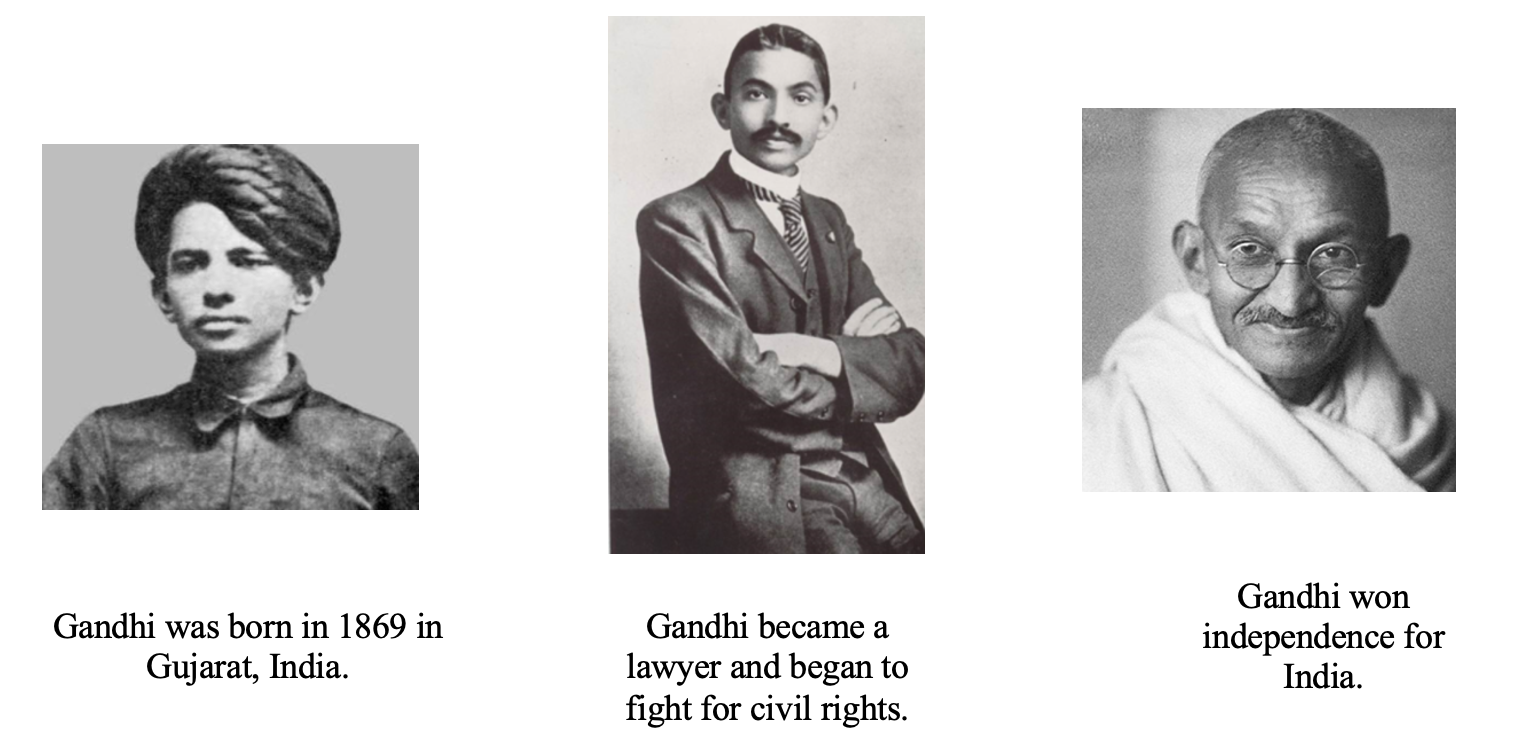
Example:
Student 1: In the beginning, Gandhi was born in 1869, in Gujarat, India.
Student 2: Subsequently, Gandhi became a lawyer and began to fight for civil rights.
Student 3: In the end, Gandhi won independence for India.
- Formative assessment: Project the images in a random order and ask groups to sequence them, using the three key phrases they’ve been practicing.
- Reflection: Students write 50-75 words on how the activity has helped them get to know the information. (Example: ‘I believe the activity helped me to understand peaceful revolution because Gandhi embodied this philosophy. I liked being able to speak about Gandhi’s life and use sequencing phrases. This helped me understand when events happened and how one affected the other.’)
- Begin the unit.
*Becoming a High Expectations Teacher
Flashcards for more image sequencing
video explanation of scaffold…

Scaffoldingmagic.com is your entryway into DYNAMIC bilingual learning methodologies, such as Phenomenon-Based Learning, CLIL, EMI, and ESL. You’ll find ways to implement critical thinking tools (DOK) to promote higher level thinking, the growth mindset, instill an ethic of excellence, deep reflection on learning, and all through multi-cultural, interdisciplinary activities. We have the keys to turning competences into action and to creating collective efficacy in your school so you move ahead as a unified, enthusiastic team.