You caught a beauty!!!

************
************

************
Download PDF of scaffold here
theory behind scaffold…
Studies show that while memorising academic language is effective in the short term – to pass exams, for instance, in the long-term it is an ineffective way of learning terms that students can use in context*. Without having analysed, compared, categorised, and defended their own ideas through the use of these terms, most students will forget their meanings as quickly as they learned them.
What can we do? The solution is easy. We create opportunities for our students to analyse, compare, categorise, and defend their own ideas through the use of these terms.
And let’s add one more element: writing. According to experts, writing is the most difficult skill for language learners to master. The challenge lies not only in our students using their cognitive skills to generat and organise their thoughts, but also in transferring their ideas into comprehensible prose – all this, and in the classroom language as well!
The meta-skills involved in writing are highly complex. When language learners compose their thoughts to put into writing, not only do they have to attend to the lower level skills of spelling, punctuation, word choice, etc , but of the higher level skills, including planning and organising, plus expressing themselves in the classroom language.The challenge becomes even more pronounced if even proficiency in their home language is weak.**
This scaffold combines the development of visual, verbal and writing skills to raise the assimilation of academic language, so that students’ linguistic development is supported on three rising levels. We suggest the added inclusion of translanguaging (judiciously using translations of students’ home language to clarify terms), to surround the student with as many support beams as possible, thus making the successful assimilation of difficult terms more likely – in the classroom and homelanguage.
At its base, this scaffold makes the learning points visible to students, which is a key component in encouraging our students to interact more enthusiastically in their own learning. ***
* Zwiers, Jeff (2011), Academic Conversations Stenhouse Publishers
+* Richards, Jack C. and Renandya, Willy A. (2002). Methodology in Language Teaching, New York, Cambridge University Press.
*** Hattie, John Visible Learning
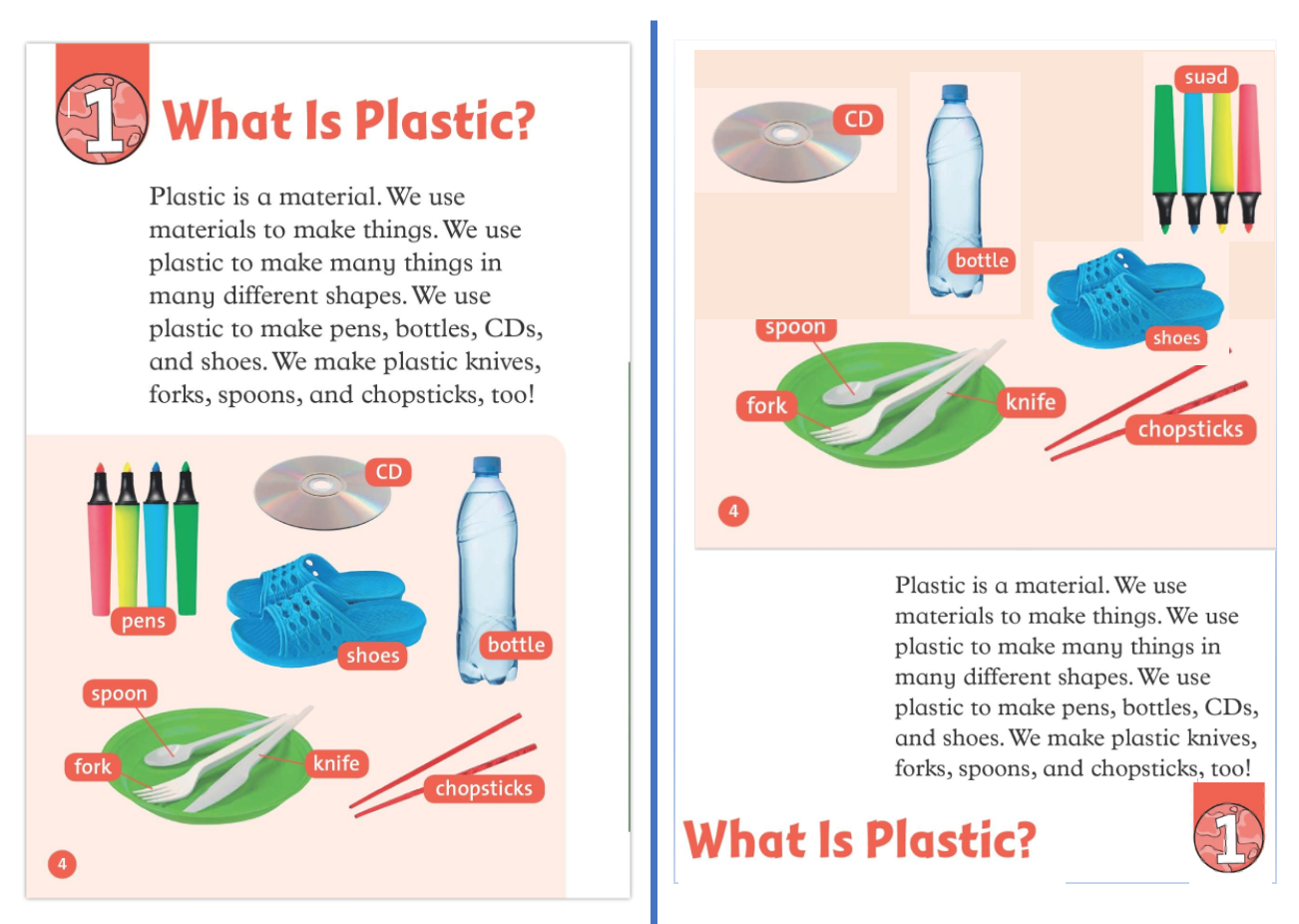
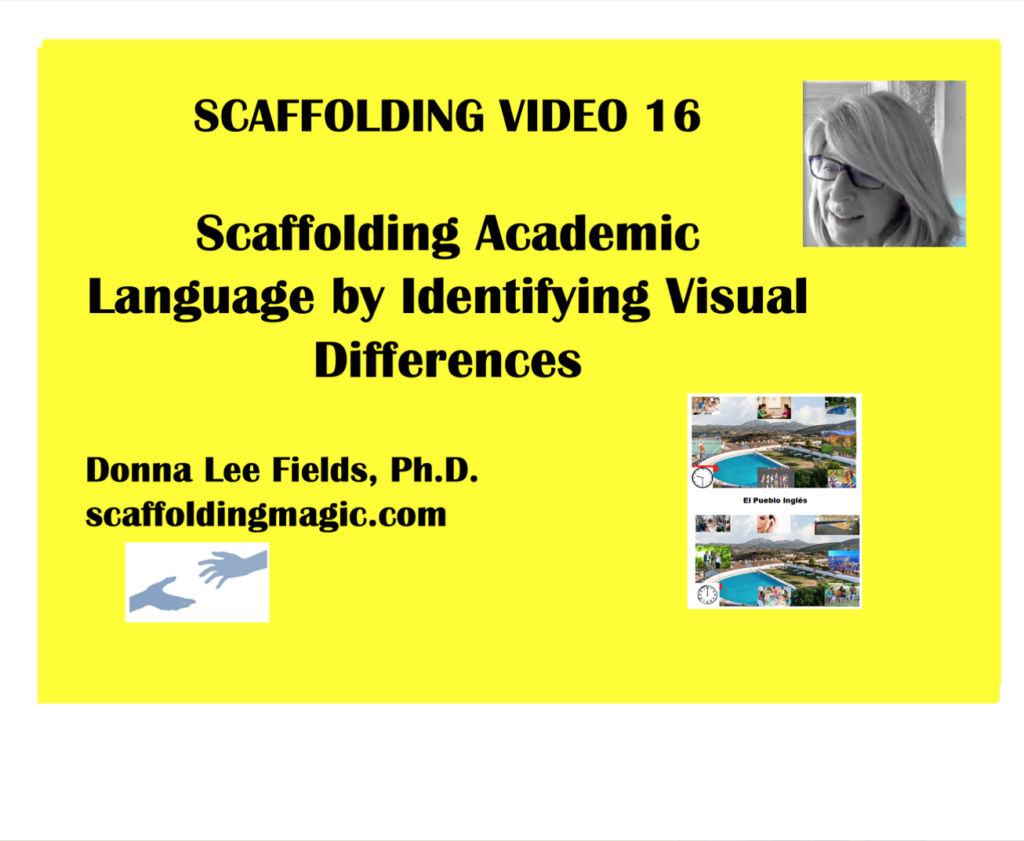
NOTE: The concept of this scaffold is to use an image from a page in the students’ books, duplicate it, change the position of images in the two, and then students work together to find, verbalise and write the differences between the two images.
There are two ways to create this scaffold: 1) using supplementary images of terms that do not appear in the main image, and 2) using only the main image and manipulating the position of its elements. You’ll see examples of different ways to create this scaffold below.
Step by Step:
- Choose a page with an image from a lesson, unit or project you are about to begin.
- Enlarge the image and make two copies of it.
- On one of the copies you’ve made, cut and paste images and text so that everything is found in a different place on the second page. (See example below.)
- Prepare and give your students a list of prepositions of location, and cardinal numbers.
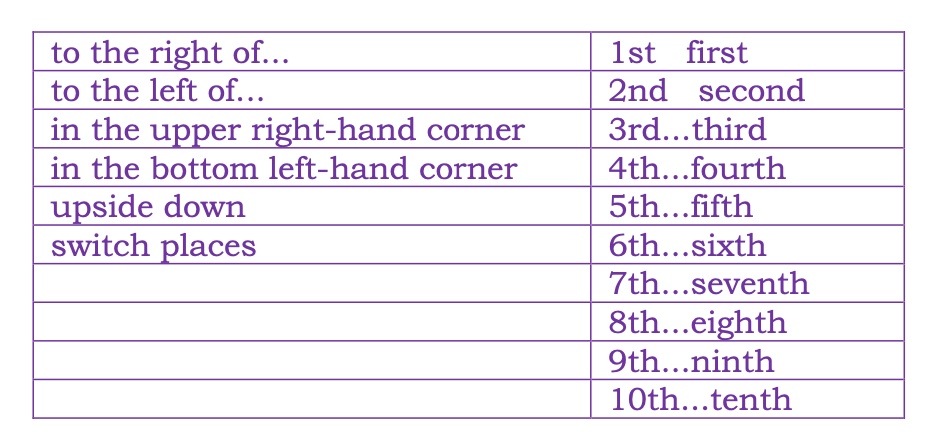
- Explain that they will work together in pairs to verbalise the differences they see between the two copies. They repeat everything each of them says (thus reinforcing academic language and prepositions of location.)
Example…
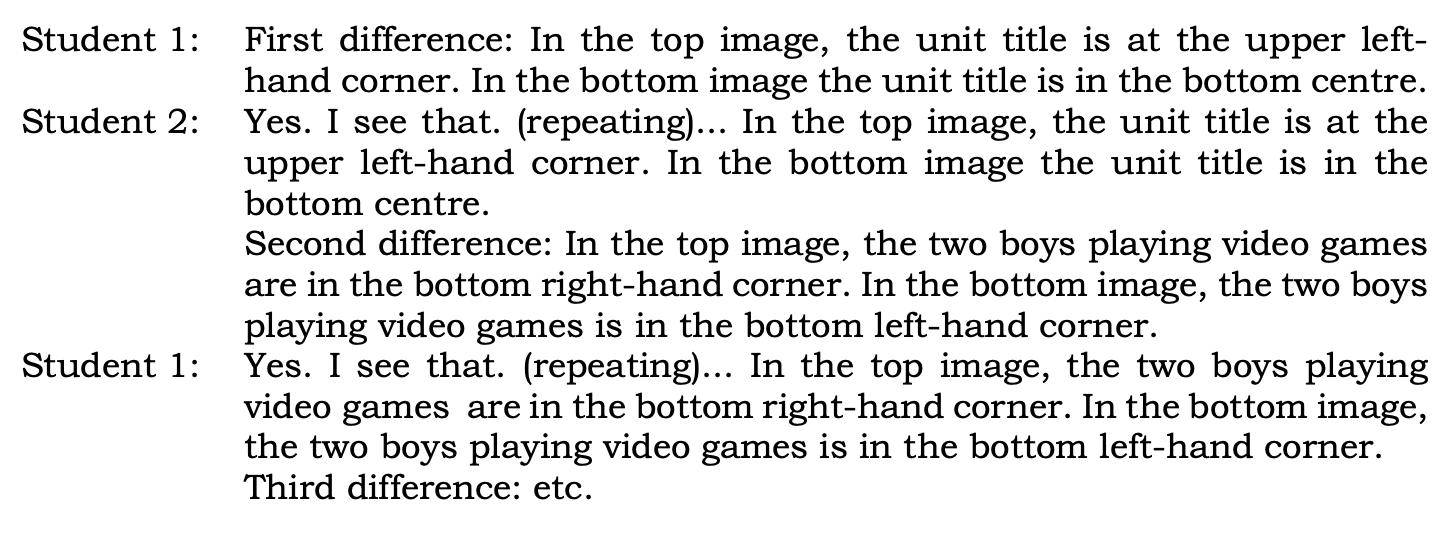
(Remember – we need to maintain high expectations. These sentences are not extremely complicated, they are simply putting together all the information that the students have in front of them. If we model doing this, they will be able to – maybe not the first or second time, but by the third time, you’ll see how proud your students are of their ability to form these extended sentences.)
video explanation of scaffold…
Reflection: Students answer the following questions from the Question Continuum. (Remember, some questions reflect content and others reflect methodology thus augmenting even further self-efficacy.)
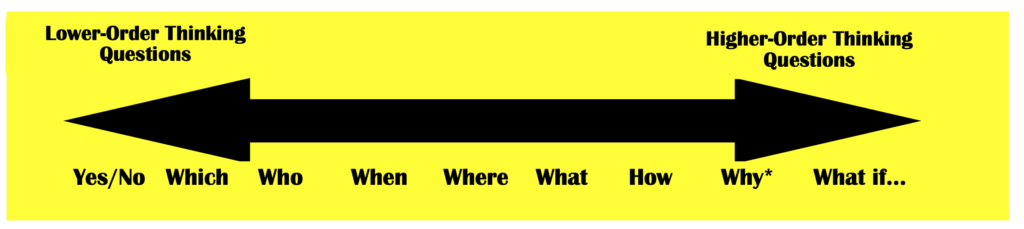
- Do you recycle?
- Which objects do you toss in the rubbish that could be recycled?
- Who do you know who doesn’t recycle?
- When did recycling begin?
- Where do you go to recycle?
- What is the difference between tossing something in the rubbish and recycling?
- How are objects recycled?
- Why do we recycle?
- What if you were asked to build a recycling plant in your town? What type of recycling would you focus on?
find more scaffolds here…

Scaffoldingmagic.com is your entryway into DYNAMIC bilingual learning methodologies, such as Phenomenon-Based Learning, CLIL, EMI, and ESL. You’ll find ways to implement critical thinking tools (DOK) to promote higher level thinking, the growth mindset, instill an ethic of excellence, deep reflection on learning, and all through multi-cultural, interdisciplinary activities. We have the keys to turning competences into action and to creating collective efficacy in your school so you move ahead as a unified, enthusiastic team.