
You caught a beauty!!!
************

************

************
Download PDF of scaffold here.
theory behind scaffold…
One of the most common go-to words to explain scaffolding is ‘chunking’. Chunking is the strategy of breaking down material into digestible proportions in order to avoid cognitive overload. If you accept the studies (and there are a lot of them and they are consistent in this conclusion) that the human mind is able to only process seven new elements at a time, chunking information gives students the emotional and cognitive space to transition more easily into new knowledge. When we add strategies in activities that promote critical thinking, collaboration, negotiation and prediction – all through visual means – we’ve created a powerful means of presenting new ideas to our students.
This scaffold technique also includes categorisation which, according to Morton Hunt*, one of the pioneers of the study of the mind, has been proven to yield educational efficiency and helps the brain process information more fluidly. Depending on the topic, making the effort to categorise new knowledge can help students feel more connected to the world around them, and make sense out of what can feel like chaos at times.
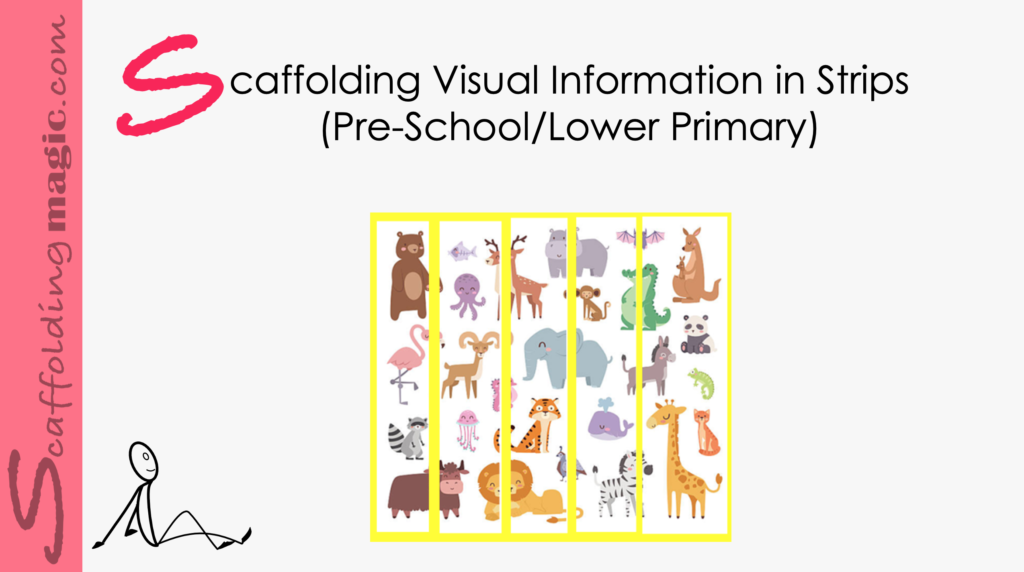
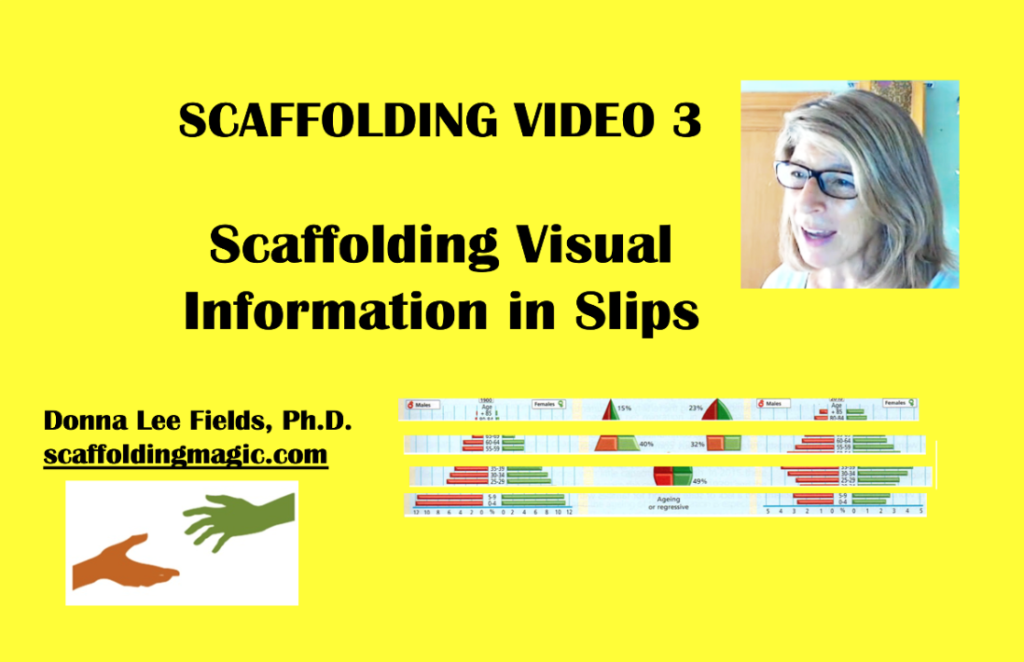
In this case, students work in pairs (or groups of three) to piece together the meaning of an image that has been intentionally divided into chunks (strips). They verbalise what they see and predict what they believe will appear on the next strip. The study, negotiation, conversation, and deliberation of this process leads to a deeper understanding of the underlying concept. When text is included in the activity, linguistic categories are added to the complexity of their conversations and predictions.
The strategy of making predictions actively engages students. It helps them to make connections between prior knowledge and the information they see before them. With activities such as this scaffold, students will learn the habit of thinking ahead, refining, revising, and verifying their predictions. Further, embedding opportunities for suppositions in activities is a valuable way to assess student comprehension of subject matter (formative assessments).**
The example given here is from a lesson on the differences between wild and domestic animals, and you’ll see how you can easily adapt it to any unit you’re about to begin.
step by step…
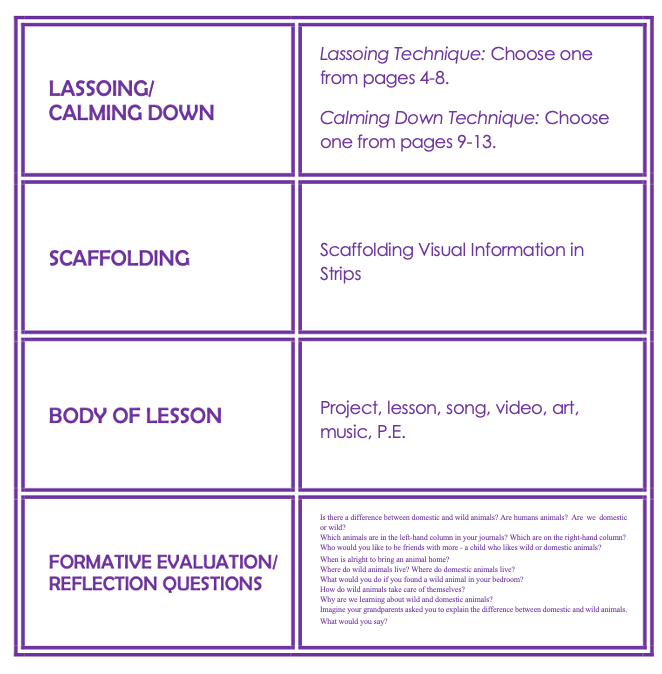
- Choose an image from the lesson you’re about to begin. (3-year-olds without text, 4- and 5-year-olds with a few large words).
- Paste it onto an A4 piece of paper.
- Print enough copies for each pair of students. (If possible, on different coloured pieces of paper so as to sort and order them more easily.)
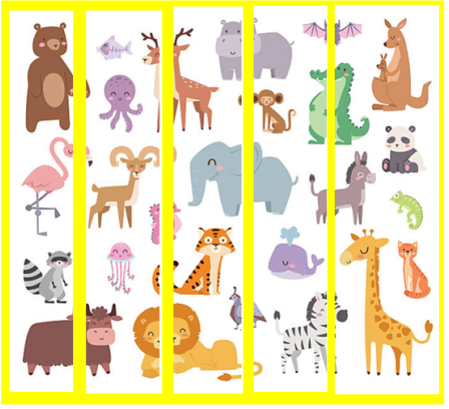
4. Cut the photocopies into either vertical or horizontal strips with a cutting board. (See example to the left.)
- Give one set to each pair of students and take the time to show them how to divide the strips up evenly between themselves. (If you’ve never done this before, this is the perfect opportunity for the cross- curricular inclusion of mathematics and the concept of dividing up something equally. Each time you do an activity, you can monitor how they progressively absorb the concept. This fosters self-efficacy, which according to John Hattie is the 11th highest educational practice (out of 250) that we can use to heighten the power of learning in the classroom.)
- Possible conversation to model dividing up strips evenly between students, and the concept equanimity.
- ‘If I give one strip to Paul and one strip to Fahmina, do they have the same number of strips?’
- ‘They have the same number of strips, so we have divided up the strips evenly.’
- ‘If I give one strip to Julio and two strips to Raija, do they have the same number of strips?’
- Raija has more strips than Julio, so we haven’t divided up the strips evenly.’
- ‘If I keep 5 strips and I give 2 strips to Fionna, does Fionna have the same number of strips as I do?
- ‘I have more strips than Fionna so we haven’t divided up the strips evenly.’
- ‘Clarissa is my partner. She takes 4 strips and gives me 4 strips. Do we have the same number of strips?
- ‘Clarissa has divided up the strips evenly.’
- ‘Now, how long do you think it will take you to divide these 10 strips evenly with your partner?’
- You can interact with the strips in the following way:
- Hold up one strip of the set you have. Ask students to find the same strip in their set.
- Ask students in pairs to whisper to each other any word that comes to mind about the strip they are holding.
- Ask Group 1 to tell their classmates what words they think of when they see that strip.
- Ask Group 2 to add any words about the strip.
- Ask Group 3 to repeat what Group 1 and 2 said.
- Ask Group 4 name all the colours in the strip.
- Ask Group 5 if they forgot any colours and to add any not said yet.
- Ask Group 6 to predict what might be on the strip next to it.
- Pick up the next strip and go through the same dynamic, including whether they guessed accurately what was missing from the strip before.
- Continue this dynamic until the image has been put back together.
- Formative Assessment: In their journals, students draw a vertical line down the center of one page. For 3-year-olds, they write the letter ‘W’ on the left column and ‘D’ on the right column. For 4-5-year-olds, they write ‘Wild’ on the left column and ‘Domestic’ on the right column. Then, they draw 2-3 animals in each column. You ask students to share their drawings and the others give feedback as to whether they’ve drawn animals in the appropriate column.
(4-5-year-olds can write the name of the animals if they are motivated to, but we don’t need to put emphasis on this.)
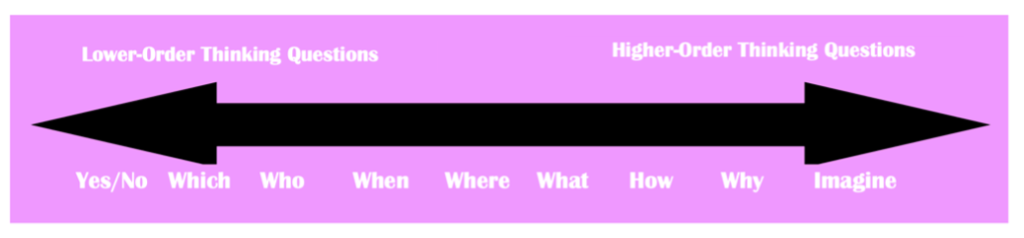
Reflection: Use Question Continuum to formulate questions about the activity. Remember to include some questions about content and some about methodology. This also augments self-efficacy – recognising the learning process and becoming conscious of how we learn best.
- Yes/No Is there a difference between domestic and wild animals? Are humans animals? Are we domestic or wild?
- Which Which animals are in the left-hand column in your journals? Which are on the right-hand column?
- Who Who would you like to be friends with more – a child who likes wild or domestic animals?
- When When is alright to bring an animal home?
- Where Where do wild animals live? Where do domestic animals live?
- What What would you do if you found a wild animal in your bedroom?
- How How do wild animals take care of themselves?
- Why Why are we learning about wild and domestic animals?
- Imagine Imagine your grandparents asked you to explain the difference between domestic and wild animals. What would you say?
*Hunt, Morton (1982). The Universe Within: A new science explores the human mind. Simon and Schuster.

Scaffoldingmagic.com is your entryway into DYNAMIC bilingual learning methodologies, such as Phenomenon-Based Learning, CLIL, EMI, and ESL. You’ll find ways to implement critical thinking tools (DOK) to promote higher level thinking, the growth mindset, instill an ethic of excellence, deep reflection on learning, and all through multi-cultural, interdisciplinary activities. We have the keys to turning competences into action and to creating collective efficacy in your school so you move ahead as a unified, enthusiastic team.