
You caught a beauty!!!
************

************

************
Download PDF of scaffold here.
Download PDF of this scaffold here.
theory behind scaffold...
Many language teachers will lament that getting their students excited about writing is probably their biggest challenge. However, the act of writing is so beneficial – in any language – that it’s one of the four skills that we ought do our best to integrate in our lessons.
Writing is one of the four cornerstone skills of every inclusive educational curriculum. It helps us form our thoughts into coherent verses and communicate over distance and time. It is a skill usually approached as a way of appeasing bands for standardised exams, but, in fact, is the perfect tool to foster the development and expression of empathy. As scientist Neil deGrasse Tyson says:
The process of sorting through different words, deciding on a structure that reflects our opinions, evaluating opinions in order to retain or discard unnecessary information, all foments essential connections in our brain so that language goes deeper and speaking becomes more fluid. Clear writing is a sign of clear thinking.
When learning languages, the common thinking is that we understand (input) close to 30% more than we can speak (output). If you want some of the biology to explain this, language is processed in a specific area of the brain in the temporal lobe; however, input and output are separated. Wernicke’s area deals with language understanding and comprehension, while Broca’s area in the frontal lobe handles speech language production. Comfortingly, in most cases, though they are in different regions of the brain, both of these areas are connected by a bundle of axons known as the arcuate fasciculus.
Writing activates the communication between these axons so that input becomes output. So, the more we interact with the process of writing, the more fluid the connection and the more fluid speech becomes. To know more about this, look at this video that shows the difference between myelinated and unmyelinated neurons.
Myelinated neurons are formed by repetition and intentional use. When this happens, white fat (myeline) forms around them and information flows more quickly and effectively. (Don’t be afraid of the word ‘fat’ here; the brain is 60% fat and directing it to where it’s more effective augments learning.)
One of our responsibilities as language teachers, especially in this day in age of countries and cultures folding on top of each other, is to help our students to become more knowledgeable and so more accepting of diversity. This includes giving our students opportunities to see the world through other people’s eyes, whether they have different customs, religions, sexual preferences, experiences, languages, ways of showing emotions, or a myriad of other anomalies.
You probably know what’s coming next…
we can use writing to help language to go deeper into our students’ temporal lobes while at the same time giving them opportunities to become more empathetic global citizens.
Not a bad segue, right?!
So, let’s cut to the quick: what is empathy? Empathy is a way of connecting with other people in such a way so that you show you understand what they’re experiencing – and that you respect their experience as something meaningful – even though you may not understand exactly how it feels for them. In other words, empathy is about finding a way to connect and to be able to say:
I want to understand how this feels to you and let you know that…
- …I will try to help.
- …I have been through something similar.
- …I have never felt that way, but I have felt something similar and I will do what I can to help you.
- … you are not alone.
Empathy is different from sympathy in that it goes beyond an intellectual understanding of what someone is experiencing, and into the realm of sensitivity and vulnerability. An empathetic response means that a person is willing to listen to differing opinions and accept different perspectives based on life-experiences.
Let’s foster the development of empathy through a multi-cultural activity that promotes critical thinking. What do you think?
step by step:
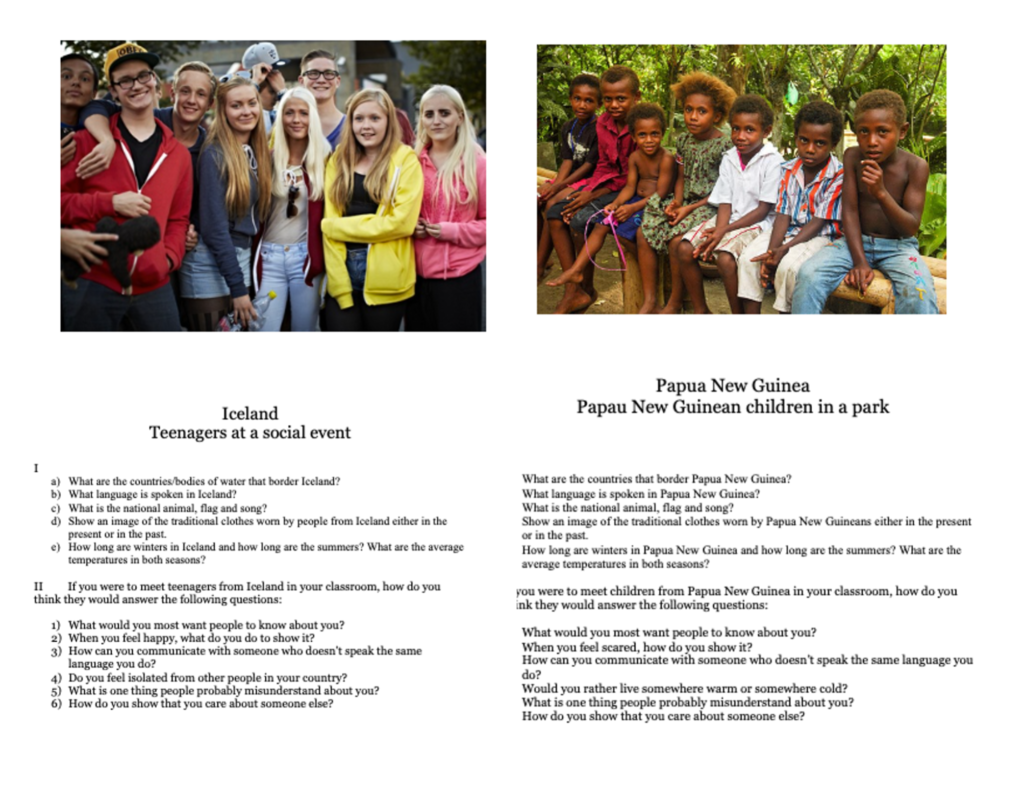
- Distribute one of the photographs in the attached document to each group of students.
- In their groups, students research the questions in Part I, and answer all of them.
- Students write a dialogue about an imaginary meeting they have with the children in the picture they have researched, and then act it out in front of their classmates.
- The other groups give each presenters feedback according to the four rules of respectful feedback.
- Discuss any differences of opinion groups may have.
Example of Lower- and Higher-Order Questions that elicit empathetic responses:

Ukranian teenagers and their families leaving their country
Part I Lower-Order Questions:
- What are the countries that border Ukraine?
- What language is spoken in Ukraine?
- What is the national animal, flag and song?
- Show an image of the traditional clothes worn by Ukraines either in the present or in the past.
- How long are winters in Ukraine and how long are the summers? What are the average temperatures in both seasons?
Part II Higher-Order Questions:
If you were to meet these teenagers, how do you think they would answer the following questions:
- What would you most want people to know about you?
- When you feel sad, what could help you to change your mood?
- How can you communicate with someone who doesn’t speak the same language you do?
- If you saw someone in the street who was hurt, what would you do?
- What is one thing people probably misunderstand about you?
- How do you show that you care about someone else?

Scaffoldingmagic.com is your entryway into DYNAMIC bilingual learning methodologies, such as Phenomenon-Based Learning, CLIL, EMI, and ESL. You’ll find ways to implement critical thinking tools (DOK) to promote higher level thinking, the growth mindset, instill an ethic of excellence, deep reflection on learning, and all through multi-cultural, interdisciplinary activities. We have the keys to turning competences into action and to creating collective efficacy in your school so you move ahead as a unified, enthusiastic team.