
You caught a beauty!!!
************

************

************
Download the PDF of this scaffold here.
theory behind scaffold…
There are almost as many definitions of what a scaffold is as there are scaffolding techniques. Jerome Bruner theory of scaffolding emerged through the socialist constructivism era in the 1970s, largely influencing, of all people, Leo Vygotsky. Bruner believed that scaffolding of learning traditionally refers to a way of structuring the learning task where an adult helps a learner “to internalise knowledge and convert it into a tool for conscious control” (1985, p. 25).
For our purposes, we can take Bruner’s core message and use it for our Secondary students, supporting them in understanding more fully the videos, podcasts, movies they immerse themselves in daily. We’ll use the experts’ insistence, as well, that when using dialogue, scaffolds will only work when questions are asked. A scaffolding activity will elucidate concept knowledge when students are given an opportunity to reach new insights as a result of. a switch in perspective.
(In fact, the ability to switch perspective is essential to learning in every domain. For those who follow Deepak Chopra and his deeply rooted scientific conclusions regarding the human condition, the more effort we make in seeing a situation through the perspective of someone we are offended by or disagree with, the more we heal on a cellular level – both emotionally and physically.)
If you are working through Mini-Lessons (and we hope you are!), the Body of the Lesson for this scaffold is the video, movie, podcast, play, that the students will watch afterwards. They are going to read chunks of dialogue taken from various tracks and 1) speak the lines aloud, 2) make educated guesses as to the mechanics of the dialogue (who is speaking, who is the person speaking to, why, etc.), 3) predict what the historical context of the dialogue, and 4) verbally, and from their notes, groups join together and collectively negotiate meaning of the source and arrive at conclusions. After watching (reading, listening to) the source, students discuss the differences between the conclusions they came to and what they saw.
The example given below is from a podcast on triage – its history, the differences in how it is carried out in various parts of the world, the philosophy behind it, etc. You will see how you can easily adapt the scaffold for your own purposes.
step by step…
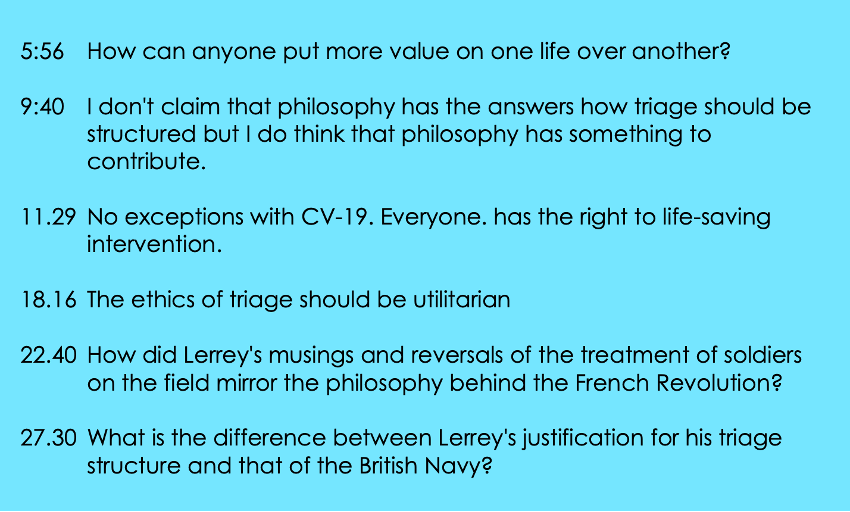
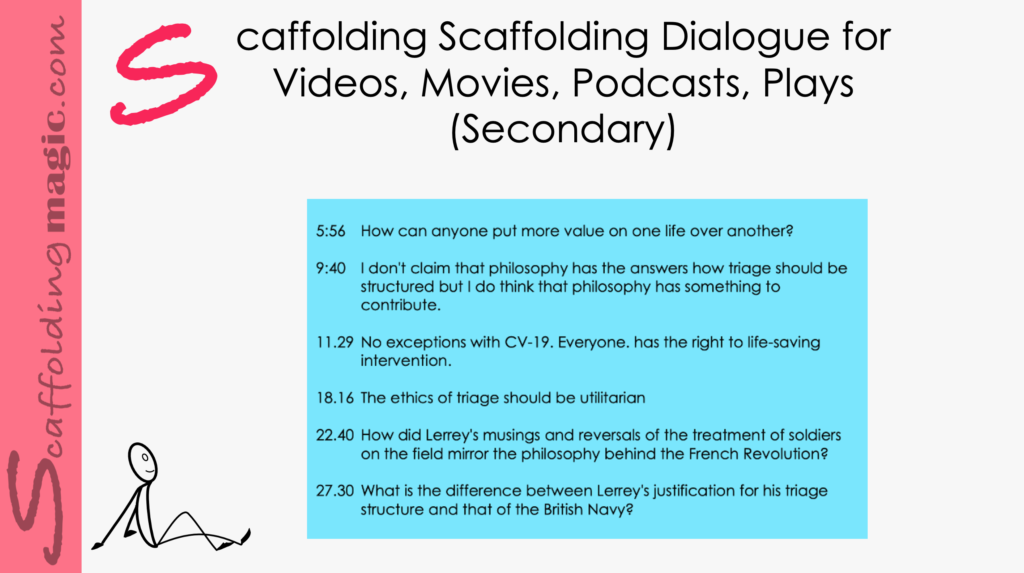
- Choose 5-10 chunks of dialogue from the source. Include time markers whenever possible. (For a literary source, include the page numbers.)
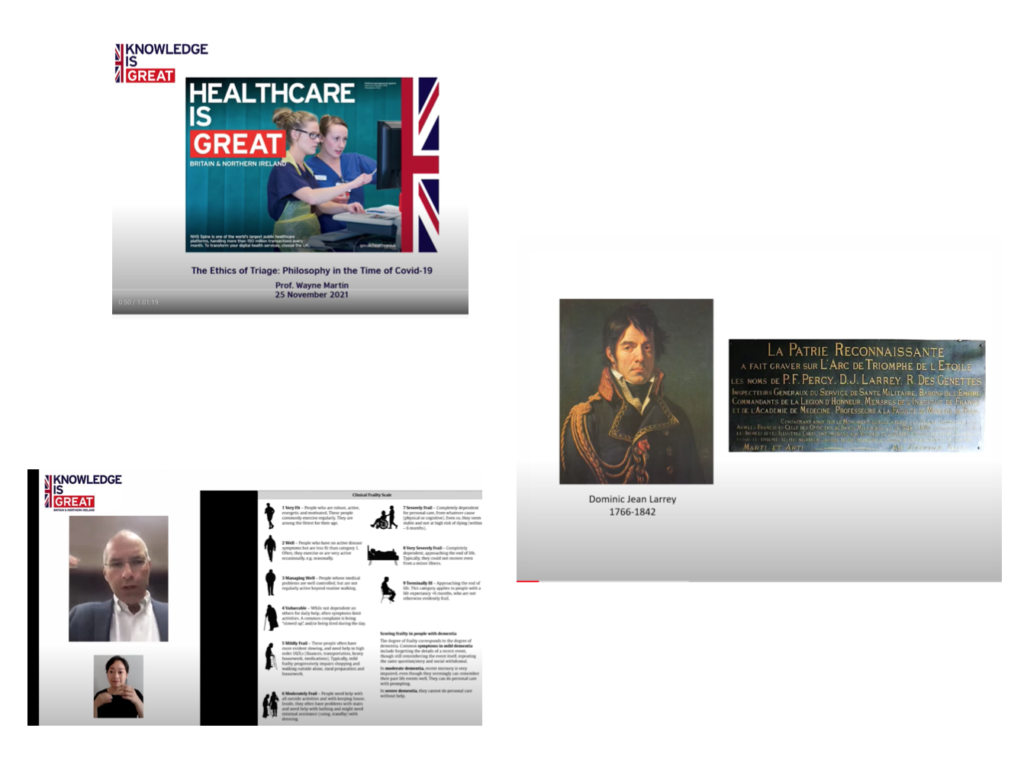
- Choose a variety of images from the source. This will give the students more reference/context for the dialogue. In the case of a narrated documentary, search for images that reflect parts of the dialogue you’ve chosen. (See a template here.)
- Print out one set of dialogue and images for each group of students.
- Students read the dialogue aloud, one chunk at a time.
- They make predictions about the chunked dialogue through written notes, including the following:
- who is speaking?
- why?
- what was being said before?
- what is said after?
- what is the overriding theme that inspired the dialogue?
- how is the person feeling who is speaking?
- how are the people (person) feeling who are being spoken to?
- what is the setting?
- what is the overriding theme?
- what else may happen to bring the dialogue to a completion?
- Students watch, listen to or read the source material.
- As a class, groups share the similarities and differences between their conclusions and the source they’ve just watched (read, listened to)
- Changing Perspective: They choose one character, narrative point, setting, situation that they don’t agree with, a conflict that offends them, the use of a word that is triggering, and write a paragraph on why it was chosen, what could have inspired the writer to use it, and what the effect was on the source as a whole.
- Students share their written perspective change either verbally or in written form.
- In the Formative Evaluation/Reflection, include a question about how this last step – changing Perspective – affected them on an emotional level.

Scaffoldingmagic.com is your entryway into DYNAMIC bilingual learning methodologies, such as Phenomenon-Based Learning, CLIL, EMI, and ESL. You’ll find ways to implement critical thinking tools (DOK) to promote higher level thinking, the growth mindset, instill an ethic of excellence, deep reflection on learning, and all through multi-cultural, interdisciplinary activities. We have the keys to turning competences into action and to creating collective efficacy in your school so you move ahead as a unified, enthusiastic team.