
************

************

************
Download PDF of scaffold here.
theory behind the scaffolding…
Higher-order level questions – those that elicit deeper thinking – help students to stretch their thinking and engage their curiosity, their reasoning ability, their creativity, and independence. These questions encourage students to open their minds, they offer opportunities to produce original thinking. A well-structured question sparks perspectives that might not have at first occurred to us; they encourage us to look at the issue from different perspectives. Higher-order level questions inspsire fresh and sometimes even startling insights and ideas, they open roads for wider perspectives of the issue, and enable teachers and students to work together in constructing understanding. If we use effective questioning skills in the educational environment, we help our students to be more effective thinkers now and in the future.*
In the professional world, effective questioning skills can often be the difference between gaining employment or not. One of the highly ranked skills wanted by employers is to ask insightful questions that lead to various solutions of challenging events.
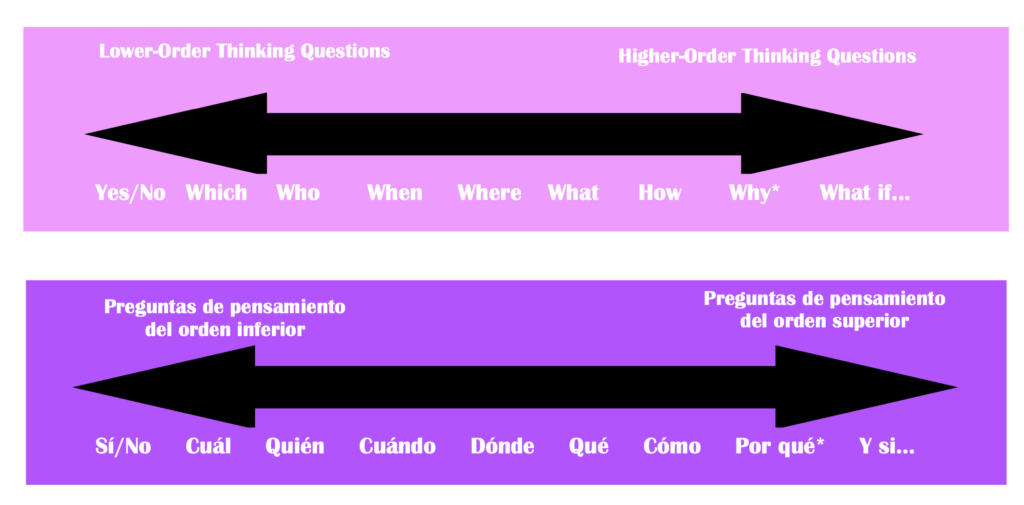
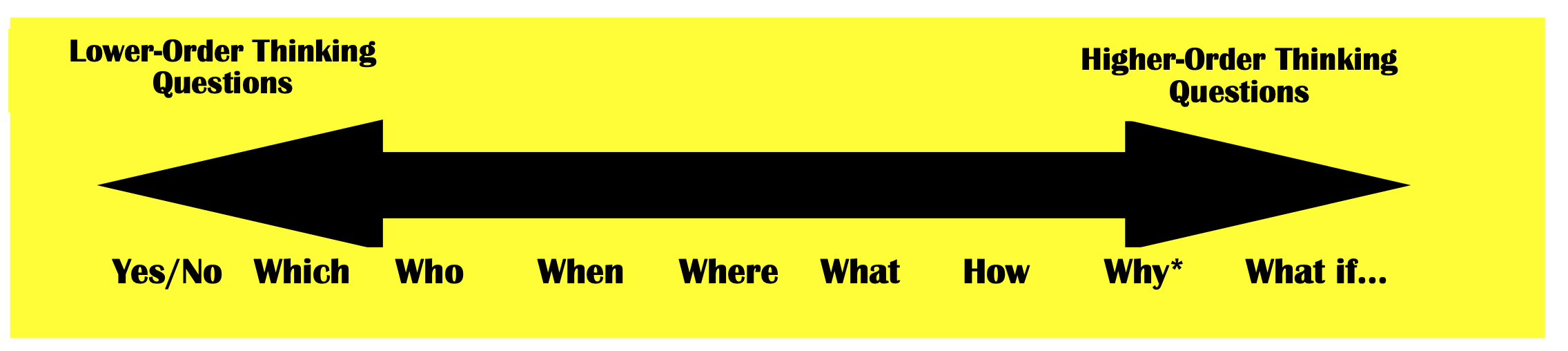
This scaffolding activity uses the question continuum – a range of interrogatories that graduate from lower- to higher-level thinking. The discussions these questions evince are especially useful for units filled with graphs, tables and other statistics – elements that are usually dense, and so very challenging to interpret.
You’ll see that the activity begins with the literal meaning of the data (lower-order thinking questions), and continue with interpretations and processing of the information (higher-order level thinking). In this way, students are gently pushed out of their comfort zone (ZPD*) and are more able to move forward in their learning.
*Zwiers, Jeff & Crawford, Marie (2011). Academic Conversations: Classroom Talk that Fosters Critical Thinking and Content Understandings, USA, Stenhouse Publishers.
**ZPD = Zone of Proximal Development: the distance between the actual developmental level as determined by independent problem solving and the level of potential development as determined through problem solving under adult guidance, or in collaboration with more capable peers” (Vygotsky).
step by step…
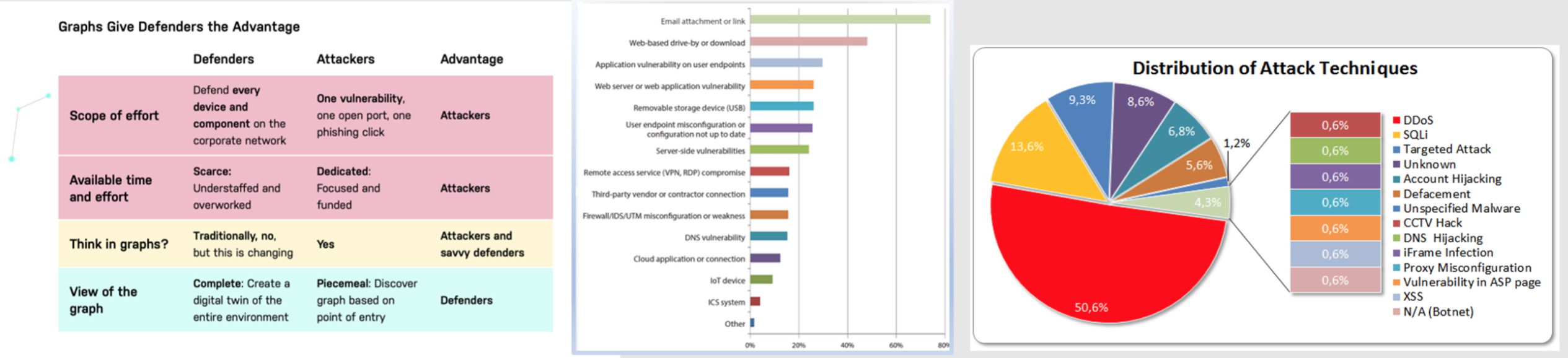
- Choose a graph or map from the unit you’re about to begin that might be challenging for your students to understand. In the example below, you’ll see that we’ve augmented the activity, including a compilation of three types of graphs, thereby extending the possibility of developing key skills.
NOTE: These maps and graphs probably see simple to us, but there is a lot of inferencing, connections, and information that our students need to cognitively unwrap. Giving them time to process the different elements of the map or graph in smaller groups, enables them to consider the information more slowly so that later feel more confident in answering higher-level order questions.
- Formulate questions using the question continuum (above) in order to guide them toward understanding the key elements you’d like them to assimilate.
Example with graphs…(they will need to cross reference these graphs to answer the questions below).
- Is it important to be able to distinguish between different types of cyber attacks?
- Which graph connects natural disasters to specific areas?
- Who would be most interested in graphs of natural disasters that did not show human losses?
- When is the most volcanic activity registered?
- Where are natural disasters most felt economically? Least felt?
- What are the differences between the three graphs? Similarities?
- How is the information for these graphs gathered?
- Why are economic consequences connected to the study of natural disasters?
- What if you worked on a team devoted to creating warnings for natural disasters. Which natural disaster would you focus on and what type of warning would you create?
- Formative Evaluation/Reflection: Students write two (2) lower-level thinking questions and two (2) higher-order thinking questions about the map(s) or graph(s) using the Question Continuum.
Other questions you can use with the graphs in your lessons:
- Do you wonder why…
- Do you think there is a correlation between…
- How do you see the difference between…
- Is there a reason why…
- Did you expect…
- Based on…how do you infer…
- Is this similar to…
- What does the graph not show?
- What else can you conclude from these findings?
- How could you present this information in a different way?
- Do you have any other questions you might like to ask about this information?
- What does the graph not show?
- What else can you conclude from these findings?
- How could you present this information in a different way?
- Do you have any other questions you might like to ask about this information?
video explanation…

find more scaffolds here…

Scaffoldingmagic.com is your entryway into DYNAMIC bilingual learning methodologies, such as Phenomenon-Based Learning, CLIL, EMI, and ESL. You’ll find ways to implement critical thinking tools (DOK) to promote higher level thinking, the growth mindset, instill an ethic of excellence, deep reflection on learning, and all through multi-cultural, interdisciplinary activities. We have the keys to turning competences into action and to creating collective efficacy in your school so you move ahead as a unified, enthusiastic team.